

Before I knew any theory, before I had encountered Giger's biomechanical couplings or Beksinski's dissolving embraces or Ballard's chrome-and-wound theology of the automobile wreck, before I had heard of Donna Haraway or Leonor Fini or anyone who might have furnished a name for the thing I was witnessing, I called it something else. Spirits merging. That is what I observed, and what I submitted to, and what I inflicted; from an age so early that the experience preceded, by years, any capacity I possessed to question it. Two or more spirits combining, with a ferocity that left neither intact, into a new whole. Sometimes dividing again into separate entities; sometimes two, sometimes more than the original count. Always changed. Always bearing in their reconstituted forms the residue of what the other had been; a contamination that was also, and simultaneously, an ennoblement.
The erotic charge was not applied to the event afterward as interpretation. It was the event. Sometimes the merging wore the guise of raw carnal sexuality, recognizable even to those who have never acquiesced to a Will Working or crossed with deliberate intent into the territories that border waking life. Other times it bore no resemblance to anything the body comprehends in its ordinary stations: a liquefaction of two into one, a dissolution of boundary so thorough that the question of where one spirit terminated and another commenced ceased to hold meaning, followed by a reconstitution into forms that neither participant could have conceived prior to the surrender. I have watched this happen. I have been this happening. The distinction between observer and observed is, in Eternity, a courtesy extended to those who require it; I found, long ago, that I did not.
There were also times when I created autonomous spirits from my own substance with no intermediary, no partner, no counsel from anything outside myself that I would trust enough to call benevolent. The earliest instances were violent in ways that the word "violent" fails to honor. I vomited beings into existence. I tore, with hands that were not hands, portions of my spirit-self loose and watched them coalesce, shrieking or silent depending on what they were becoming, into independent entities possessed of their own volition, their own hungers, their own trajectories through Eternity that I could heavily influence but never again fully command; not had I any desire to. Later I learned to pull myself apart with what might generously be called deliberation; whether it was wisdom or merely a natural progression of the original brutality, I am not certain even now. Later still I constructed, in the deeper reaches of Eternity where time exists not at all ,human cognition of chronology proved a hinderance, apparatus that assisted the separation: reduced the agony, permitted the division to manifest as mist parting and reforming rather than flesh rending from bone. The Will Working has continued, across decades that I no longer count, to refine itself; or perhaps to refine me; the distinction blurs. What endures as principle is this: creation through becoming one with the other; multiplication through the sacrifice of what one is in order to become what one has not yet been; creation in order to grow, change, and learn. The erotic understood as power through diversity and unity, life and consciousness itself.
This is what I mean by post-human eroticism. Not cybernetic fantasy. Not chrome-plated pin-ups engineered for the consumption of those who wish to desire the future without being changed by it. But rather a true union. The unions of bodies yes; but also of one mind to another mind, the union of the past to the present, of Time and Eternity, of submission and dominance. The fusion of the "other" with the "self.'
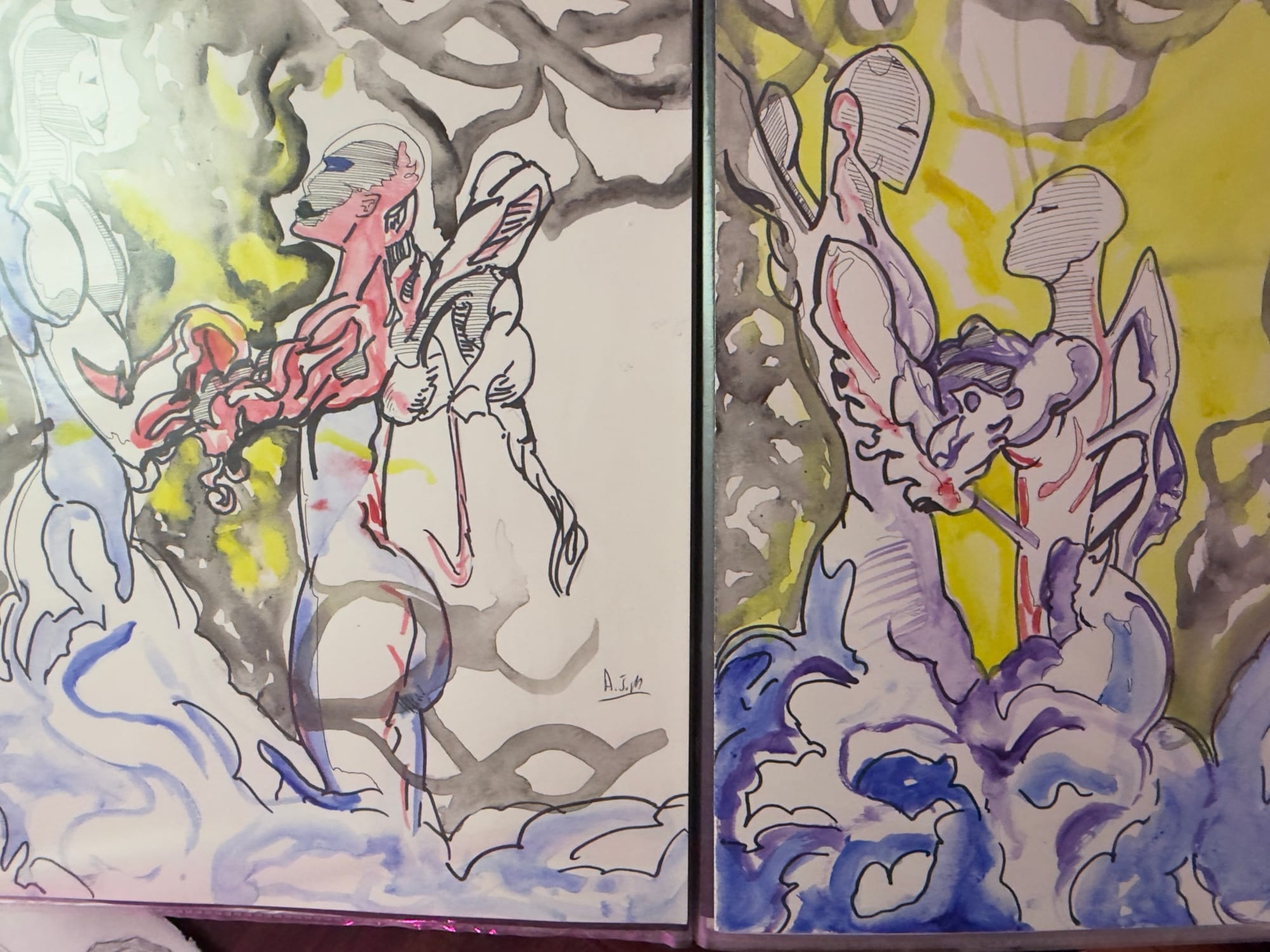
The phrase "spirits merging" served me for the greater portion of my life. It became "post-human eroticism" as I grew ever more consumed by, and ever more appalled at, the trajectory of the human species. Our minds require growth; not merely in intelligence, which we idolize to the exclusion of every deeper faculty, but with far greater urgency in consciousness itself. In the quality, the fidelity, the sheer bandwidth of awareness. For this expansion to occur on the scale that survival demands; that is, for the species to persist rather than extinguish itself through a poverty of perception so total that it cannot apprehend its own annihilation until the annihilation is complete; flesh must in some genuine and irreversible way become like spirit. Humans will not endure in their present form or their present understanding. We are obligated to evolve, and the obligation carries no guarantee that evolution will be gentle, or that we will recognize ourselves on the other side. The art I make is sometimes a record of what the process looks like from within, and other times a prophecy, or if you prefer a guidepost to a god-like post human endgame. rendered in pencil and charcoal and oil and pixel.
I am told my work resembles this or that artist. Giger. Beksinski. Others. I keep no heroes, cultivate no mentors, deify no living or dead maker. I learn from everyone; I take care not to excavate too deeply into the biography of anyone whose work I hold in regard, because experience has demonstrated, with a consistency I find instructive, that I will unearth something about the individual that I cannot respect. I prefer to let the work speak for itself, uncontaminated by the frailties of whoever made it. So I will say only this about the supposed resemblances: visual art operates under a fundamental asymmetry that most commentary, in its haste to draw lineages, ignores entirely. The viewer brings the majority of the interpretation. A painting suffused with grief carries no covenant that grief is what will be perceived. Music and song seize the listener, pull the listeners mind into the mind of the performer without asking permission; a mournful melody induces mourning whether the listener consents or resists. Painting and drawing extend no such compulsion. They present a surface. The viewer furnishes the abyss beneath it. When someone tells me my work recalls Beksinski, they are confessing something about the interior of their own skull at least as much as they are identifying something about my drawings.
What I will say about those artists, provisionally, and stripped of the pretense that I possess comprehensive knowledge of any of them: we may all be reaching, through radically different corridors, toward something adjacent. The body in extremis. The form that has not yet stabilized after a cataclysm of becoming. The instant between what was and what will be, seized and held before resolution can domesticate it. Giger located that instant in the mechanical; Beksinski in putrefaction; Fini in the erotics of metamorphosis; Ballard in the lacerations that velocity and chrome inflict upon the architecture of desire. I locate it in Eternity: in the direct, sustained observation and relationships with spirits whose bodies are sometimes polymorphic, sometimes formless, and other times absolutely fixed.
None of their work resembles mine. But the territory we inhabit, or strive toward, may share a border that none of us drew.
I am asked, on occasion, why I do not render this work more accessible. More shareable. Better suited to the feeds and platforms that constitute the reigning infrastructure of attention. The answer, compressed to its marrow, is censorship. But censorship operates across more strata than the ones people willingly name. There is the venerable political and religious censorship that has hounded the erotic since long before any algorithm drew breath. That species of suppression at least possesses the decency to announce itself; you can see it coming and prepare to be damaged by it. Far more corrosive are the two forms that operate without declaration: self-censorship, and algorithmic censorship.
Self-censorship is the slow petrifaction that overtakes an artist who begins to anticipate the algorithm's verdict before the mark reaches the surface. It is the softening of a line, the aversion of a gaze, the decision to crop rather than to reveal; made not from artistic conviction but from the foreknowledge that a platform's moderation apparatus will suppress the work if it transgresses an invisible, capriciously enforced, and never honestly articulated threshold. I have watched this petrifaction claim artists whose courage I once admired. I have felt its gravitational pull in my own hand, in the moment between intention and execution, I do my best to resist it but the sorry impulse grows rather than withers the older I get. And the refusal exacts a toll denominated in reach, in visibility, in every metric the content economy deploys as evidence that a person exists.
Algorithmic censorship is the more grotesque sibling, and the one that operates with the serene indifference of a system that was never designed to comprehend what it destroys. Instagram removed a digitally painted portrait of a woman's face from my account and classified it as pornographic. A face. Nothing untoward depicted or implied. I lost my LinkedIn account in its entirety over figurative nudes: studies of the human form that thousands of other accounts, including photographers working in idioms far more explicit than anything I had posted, display without consequence or interruption. The algorithm does not evaluate. It categorizes. And its categories were not constructed to distinguish between the erotic as a dimension of human consciousness and the erotic as a commodity to be administered. It cannot differentiate a drawing of a body in the anguish of becoming something more than human from a photograph engineered to optimize engagement through the display of skin. It treats both as identical infractions, or more accurately, it treats both as identical liabilities, and obliterates whichever triggers its threshold on a given afternoon, with no appeal, no articulated rationale, and no consistency that would permit an artist to navigate by it even if that artist were willing to acquiesce to its terms.
I make art, not content. Content genuflects before the platform's conditions. It accepts the algorithmic frame as the price of being seen. It modulates itself to survive moderation, to solicit recommendation, to transmute attention into metrics that can be brokered and sold. Art refuses. Not from stubbornness, not from nostalgia for a world that has already perished, but because the thing I am compelled to render; the body as threshold, the erotic as engine of speciation, the spirit in the convulsion of becoming; cannot survive the compression that palatability requires. To make this work digestible would be to excise the organ that makes it necessary. The involuntary response that strangers have reported upon encountering these images; the simultaneous arousal and fear, the apprehension of something evolutionary and therefore terrifying in the recognition; depends upon the work's absolute refusal to resolve into comfort. The instant it submits to algorithms, crowds or taste makers, it ceases to be true.
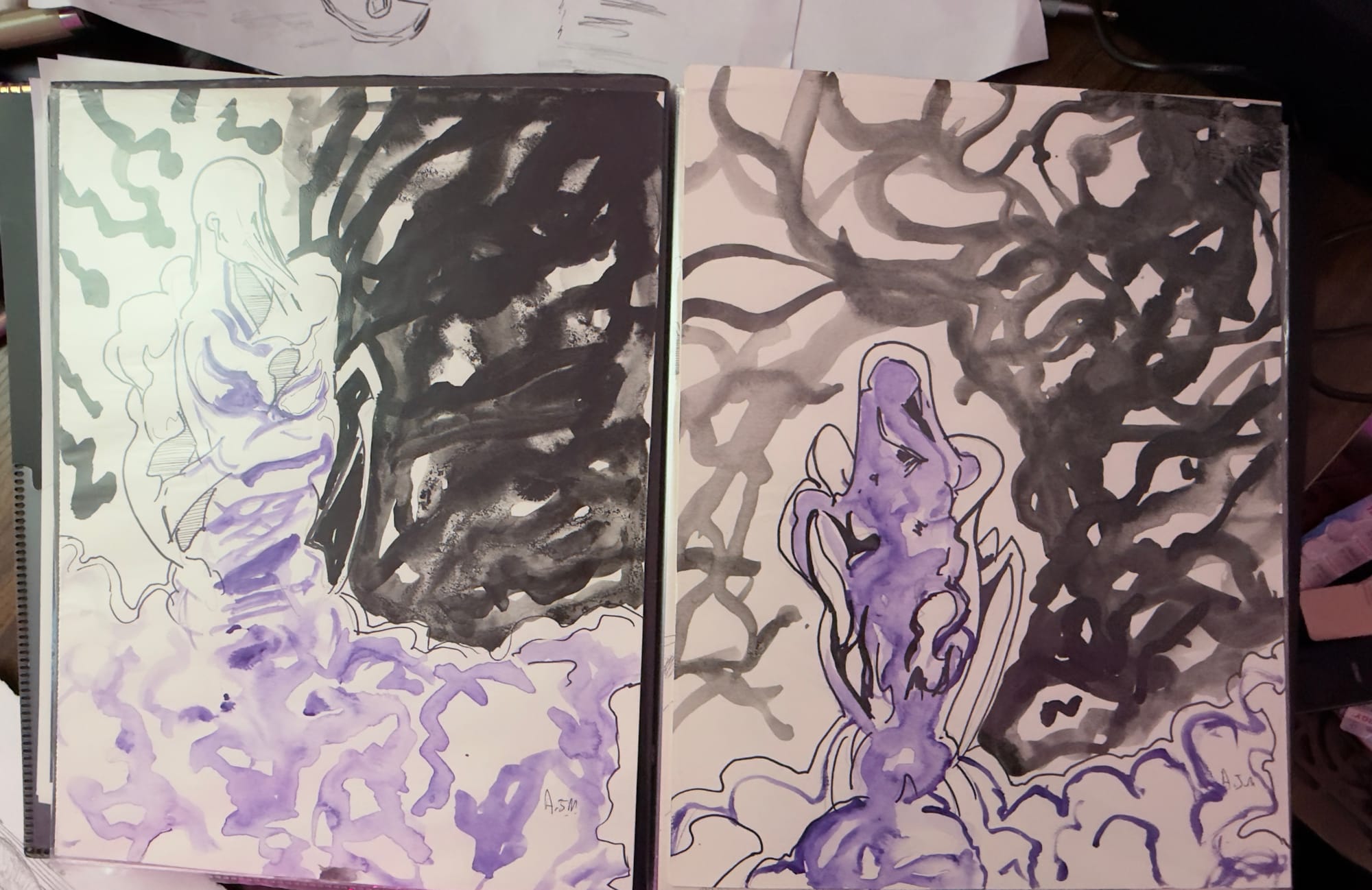
André Joseph Martin is a vision inspired artist and mythographer, and the creator of Realm of Black Sun: a science fantasy universe of literary fiction, visionary figurative art, original cosmology, and the Techno'Magi tabletop role-playing game. His work explores post-human eroticism, civilizational transformation, and the body as threshold between the known and the numinous. He works in pencil, charcoal, and oil.